
Bennu Asteroid's Secret Revealed: The Truth Emerged Months Later
The investigation that lasted for months finally concluded. The secret of the Bennu Asteroid was solved by scientists. The Bennu samples brought by OSIRIS-REx revealed that the asteroid was formed by the filtering effect of Jupiter.
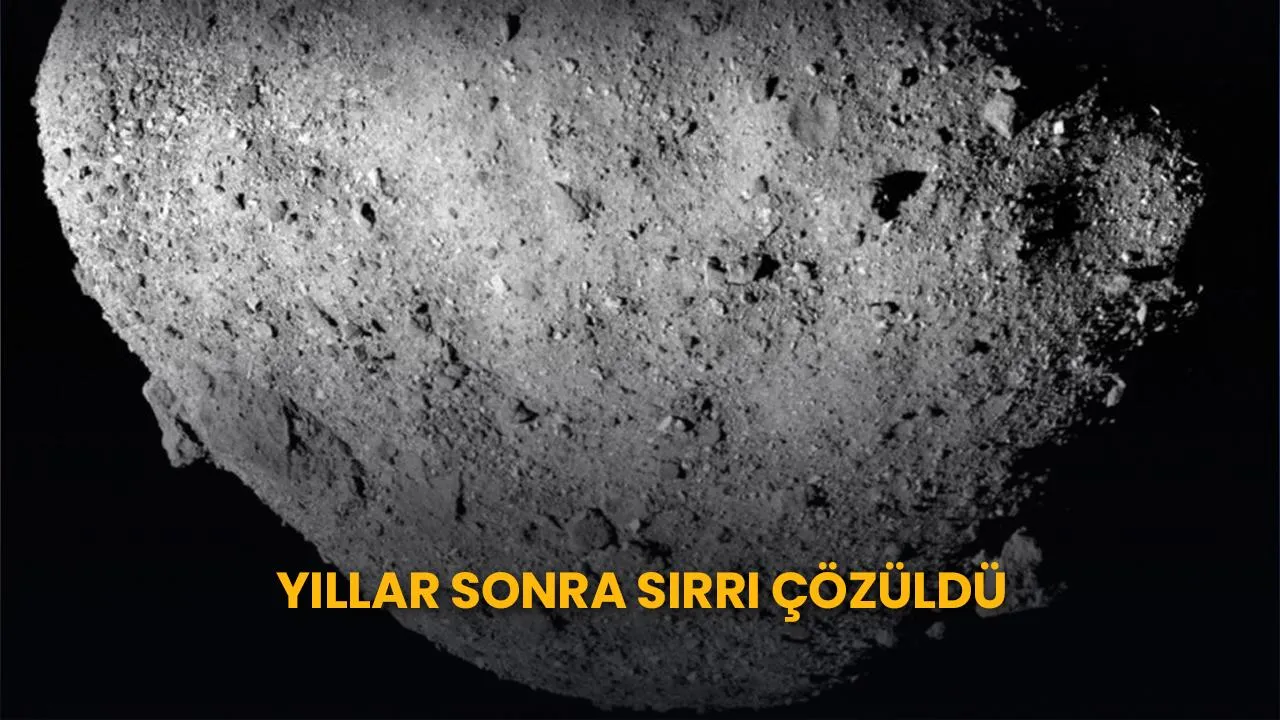
The mystery of Asteroid Bennu, which the scientific world has been working on for months, even years, has finally been solved. As a result of their analyses, scientists have reached a clear answer.
A research team led by the Swiss Federal Institute of Technology (ETH Zurich) analyzed dust samples taken from asteroid Bennu, reaching new findings regarding the asteroid's formation process. Half a gram of the 121.6 grams of material collected by NASA's OSIRIS-REx spacecraft in October 2020 and brought to Earth in September 2023 was given to the team led by Maria Schönbächler for laboratory examination.
The results of the research were published in the journal Science Advances. The findings show that Bennu was shaped under the influence of Jupiter, in a different region than previously thought.
What did isotope analysis reveal?
Scientists examined different isotope forms of iron, titanium, and chromium atoms in the dust samples. The ratios of these isotopes give planetary scientists clues as to which region the rock formed in.
As a result of the analysis, it was determined that Bennu's nucleosynthetic measurements largely overlap with asteroid Ryugu and a special group of meteorites called CI meteorites. This indicates that all three bodies originate from the same dust source in the early Solar System.
Jupiter worked like a sieve
The dust in the samples carries chemical traces belonging to both the inner and outer regions of the Solar System. According to the researchers, this mixture calls into question previous assumptions that Bennu formed in a region far from the Sun.
Instead, the team attributes the origin of the material to the region called the "water-ice line," which was located within the orbit of the then-growing Jupiter. At this boundary, the temperature was low enough for gaseous water vapor to turn into solid ice.
- Jupiter's increasing mass blocked the movement of large particles.
- Small dust grains overcame this barrier and mixed with elements in the inner Solar System.
- Ice forming at the boundary served as a binder holding these fine particles together.
According to the scientists conducting the study, this model explains why there is a measurable amount of water in the rocks on Bennu.
What does this finding change?
Isotope analysis showed that the asteroids examined are not composed solely of carbonaceous materials containing water and organic compounds, which are unique to the outer Solar System. It was also determined that they carry non-carbonaceous material characteristics, consisting of dry rocks and metals, which form the basis of rocky planets like Earth.
Researchers plan to examine other asteroids carrying the same chemical signature to more precisely measure Jupiter's influence on dust distribution. [VERIFY: Which asteroids will be examined or the timeline of the study is not specified in the source]
This article was translated from Turkish. Read the original article in Turkish.