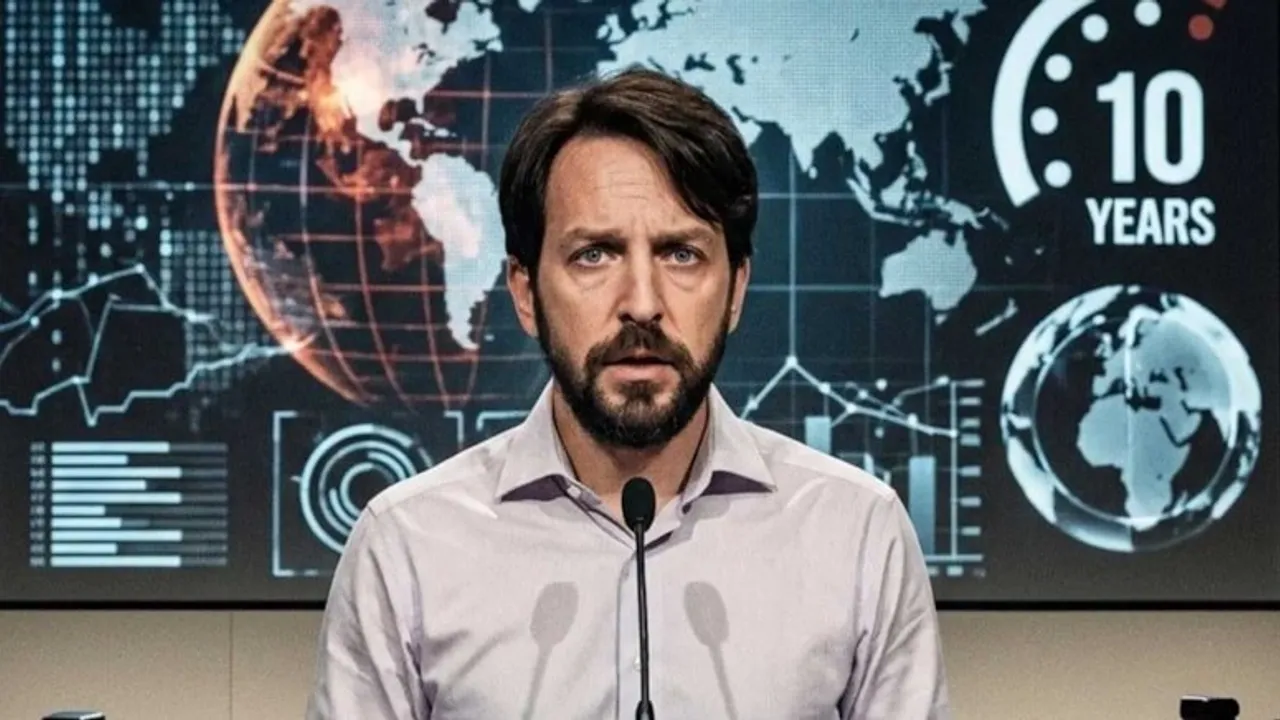
There is widespread awareness of the danger posed by artificial intelligence, and some of the people who have devoted years to the field say so openly. Nate Soares, a machine learning researcher who previously worked as a software engineer at Google and Microsoft, has argued that the probability of AI bringing about the end of humanity within the next 10 years is above 50%.
Soares laid out his views on a podcast hosted by Nicholas Thompson, CEO of The Atlantic.
He is not saving for retirement
Soares's belief in this forecast has also shaped his personal decisions. He says he has not been saving for retirement for about 10 years. He still has a 401K account from his time at Google, but he has not put a single dollar into it in roughly a decade.
Soares, who leads the Machine Intelligence Research Institute (MIRI) in Berkeley, says the problem is not that jobs will be taken away. "I'm not one of those who say 'AI will bring an unemployment apocalypse'; I'm one of those who say 'AI will kill everyone,'" he said. In this scenario, he added, full employment would be reached, and everyone would have a job just before being wiped out.
Soares's horse and car analogy
Thompson pushed back on the doomsday scenario, noting that even the most advanced AI models today carry serious errors and limitations. Soares replied that current flaws should not create false confidence, and he compared the present state of AI to the early days of the automobile. He asked people to imagine a group of horses watching the first cars being built and saying, "There are a lot of things this vehicle still can't do." Soares said AI improves every day and is increasingly able to handle longer and more complex tasks successfully.
Despite this picture, Soares said the outcome is not inevitable. He compared the situation to humanity's long experience with the threat of nuclear war. "Perhaps for the first time we are living under the shadow of the possibility that all of humanity could vanish at once, but as individuals we have always lived under the shadow of epidemics and wars. The only thing we can do is our best and try to live a good life."
Soares's remarks came about two months after three researchers working at Anthropic issued a similar warning of "extinction within 10 years." One of them, Jacob Coxon, resigned, saying that both Anthropic and its former company OpenAI were ignoring the threat and managing the process poorly.